Why I Joined the Green Party and Built a Tax Framework for the Post-Employment Economy
I am a 55-year-old infrastructure engineer from Bedford. I spent eleven years in the Royal Corps of Signals, the Gulf War, South Armagh and two tours in Bosnia (UNPROFOR and IFOR). I left the Army in 1997 and spent the next three decades building and securing large-scale computer systems: Active Directory forests spanning 360,000 users, big data security platforms processing a quarter of a million events per second, red team operations against financial infrastructure. I have spent my entire adult life inside the machinery that runs things.
Four months ago I joined the Green Party. That probably needs some explaining.
Seeing it coming
I have been saying since 2017 that automation would be the defining economic crisis of this generation. Not because I read about it, but because I build the systems that do it. When you spend your career automating processes, you develop a fairly clear picture of what happens when automation stops being a productivity tool and starts being a replacement workforce.
In 2017 this sounded like science fiction to most people. ChatGPT was five years away. Self-driving cars were a punchline. The idea that AI could replace white-collar professionals seemed absurd. But infrastructure engineers don’t think in headlines. We think in capacity planning, in growth curves, in what happens when you extrapolate the trend line past the comfortable bit of the graph.
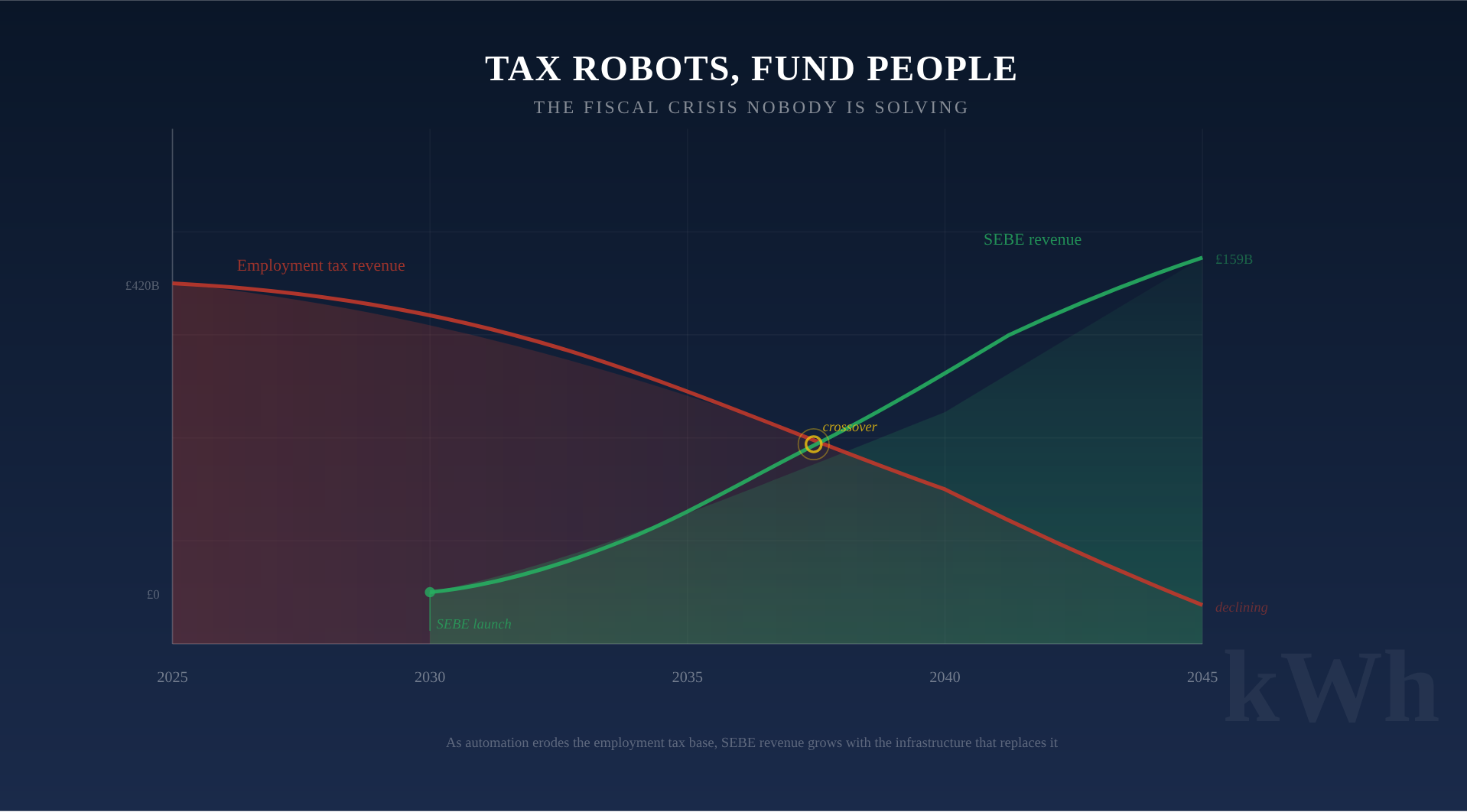
The trend line said: within ten to fifteen years, automation would be displacing workers faster than the economy could create new roles for them. That meant income tax receipts would start declining. National Insurance receipts would follow. The government raises £534 billion a year from taxing workers’ wages. That funding model has a shelf life, and the expiry date is visible from where I am standing.
The problem nobody was solving
I looked for someone who had a credible fiscal answer to this. Not a hand-wave about “retraining” (retraining for what, exactly, when the AI can learn the new job faster than you can?). Not a vague gesture toward “taxing the robots” with no mechanism. An actual, implementable tax framework that could replace the revenue that automation would destroy.
Nobody had one.
Economists were writing papers about the problem. Politicians were ignoring it. Think tanks were producing reports with titles like “The Future of Work” that described the challenge in great detail and then offered nothing actionable. Universal Basic Income advocates had the right instinct (give people money) but no credible answer to “where does the money come from?”
So I built one.
What SEBE is
Sovereign Energy and Bandwidth Excise targets the two unavoidable requirements for automation as it replaces jobs:
Energy: Every datacenter, factory and office needs electricity, from the grid or its own generators. We tax the energy consumed regardless of source.
Bandwidth: Offshoring compute? Companies use cross-border data to access this resource so we tax this at a higher rate to encourage investment domestically.
At launch in 2030, SEBE could generate £34–46 billion a year (in 2026 prices). By 2040, that reaches £93 billion. By 2045, £159 billion. Revenue grows automatically with automation deployment. The more machines replace workers, the more tax revenue comes in to support the people those machines replaced.
The model is deliberately cautious. At launch, SEBE could fund a Universal Basic Income starting at roughly £650 per adult per year (not life-changing, but universal and unconditional). As automation grows and SEBE revenue grows with it, the payment ratchets upward automatically toward a full Universal Living Income matching median take-home pay. The mechanism tracks the problem: the more jobs automation destroys, the more revenue it generates to support the people displaced.
The full workings, every assumption and every calculation, are on this site and open-source on GitHub.
Why the Green Party
I did not join the Green Party because of climate policy. I joined because they are the only UK party whose fiscal philosophy can accommodate what SEBE requires.
Labour and the Conservatives are locked into the fiction that growth will solve everything and that the tax base will somehow survive automation. None of them will touch structural tax reform because it means admitting the current system is dying.
The Green Party has an existing commitment to Universal Basic Income. They understand that the economy is changing structurally, not cyclically. Their policy framework (EC codes, the Philosophical Basis) is compatible with the kind of intervention SEBE represents. And at 195,000 members and 14% in the polls, they are no longer a protest party. They are a potential coalition partner. Which means their policies might actually get implemented.
SEBE gives the Greens something they currently lack: a credible, fully costed mechanism for funding UBI. The party already supports wealth taxes, land value tax and financial transaction taxes. SEBE completes the picture by adding a revenue stream that scales with automation itself. £34–46 billion at launch, growing every year machines replace workers. The more jobs automation destroys, the more SEBE revenue there is to fund the income that replaces them. No other tax does that.
What I am looking for
I am not an economist. I am not an academic. I have no institutional backing. What I have is a complete policy architecture built by someone who understands the infrastructure being taxed, because he spent 30 years building it.
The full proposal is on GitHub: github.com/djarid/SEBE
It includes:
- A Green Party policy submission (aligned to their existing framework)
- An academic brief (for think tanks and researchers)
- A public explainer (plain language)
- A revenue model (full workings, sensitivity analysis, cited sources)
- A distribution model (illustrative UBI to Universal Living Income transition)
Everything is licensed CC-BY 4.0. Use it. Adapt it. Argue with it.
The window for getting a fiscal mechanism in place before the revenue crisis hits is not measured in decades. It is measured in years. The work is on the table. The GitHub is open. I am looking for economists who will break the model, engineers who will probe the metering, and policy people who know how to get a proposal from a new member’s desk to a conference floor.
I published the technical case for SEBE in my previous post, Tax Robots, Fund People. This post is the personal one. I built this because nobody else was building it and because the window is closing.
The automation is not waiting. Neither should we.