The Plumbing of Post-Employment Tax
The UK tax base depends on workers having wages. Automation is removing the wages. SEBE replaces the lost revenue by taxing the energy and bandwidth that automated systems consume. If you have read Tax Robots, Fund People, you know the structure: the Sovereign Energy Excise on commercial electricity, the Digital Customs Duty on cross-border data, £34-46 billion at launch in 2030, growing automatically as automation scales.
That post explained what SEBE does. This one explains how it works. There are two versions. The first is intuitive and clean. The second is correct.
The simple version
SEBE taxes commercial energy consumption and cross-border data. At launch in 2030, this raises £34-46 billion per year (2026 prices). The government collects that revenue and uses it to fund a Universal Basic Income, starting at roughly £650 per adult per year and growing as automation (and therefore SEBE revenue) increases. Consumers pay nothing. SEBE applies only to commercial facilities above 500kW.
Tax flows in. Payments flow out. The numbers balance. Done.
This explanation is clear, defensible and wrong.
The rug pull
That is not how the UK government’s finances work. It is how your household finances work, and the confusion between the two is the most expensive misunderstanding in British politics.
You earn money before you spend it. The government does not.
The UK government is the issuer of the pound. It does not need to collect pounds before it can spend them, any more than a scoreboard needs to collect points from the crowd before it can put them on the board. When the government spends, new money enters the economy. When it taxes, money is removed from the economy. Spending creates. Taxation destroys. They are not the same money going round in a circle.
The bathtub
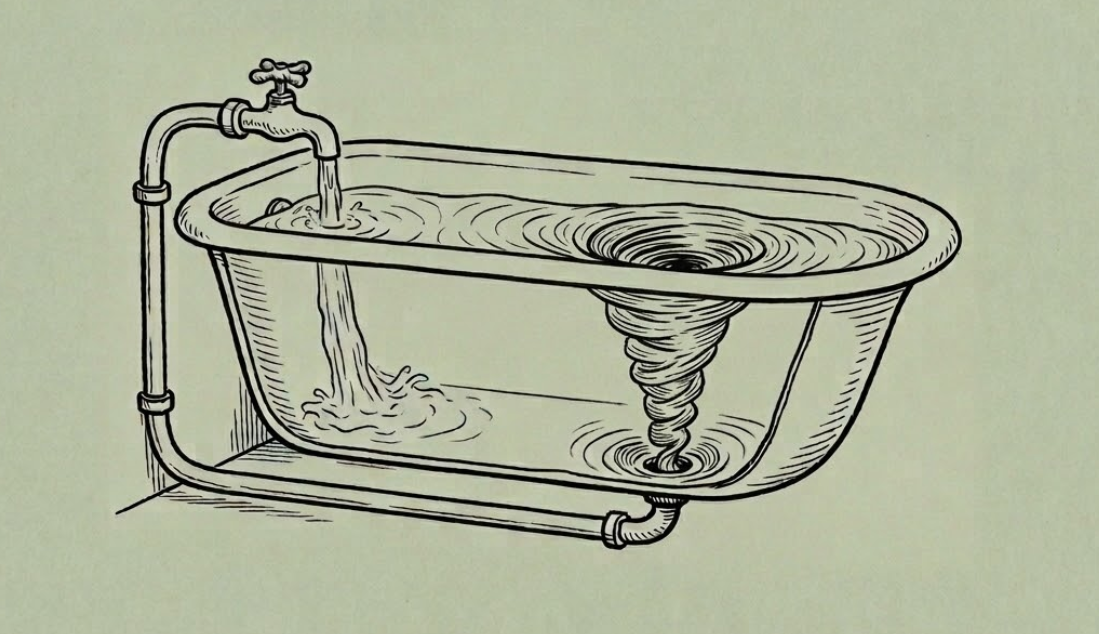
Picture a bathtub. The tap is government spending. The drain is taxation. The water level is the money supply in the economy.
Turn the tap on and water flows in. Open the drain and water flows out. If the tap runs faster than the drain, the tub overflows. That overflow is inflation: too much money chasing too few goods. If the drain is wider than the tap, the tub empties. That is deflation, recession, austerity.
The job of fiscal policy is to keep the water at the right level. Not too high, not too low.
Now here is where the conventional explanation goes wrong. It says: the government collects the water from the drain, carries it back upstairs and pours it in through the tap. That is how your household works. You earn (drain) before you spend (tap). The water in your life is finite and it circulates.
But the government’s tap is connected to the mains. It does not need the drain water. It never did. The drain exists to stop the tub overflowing, not to supply the tap.
SEBE as plumbing
In this model, UBI is the tap. SEBE is the drain. The government spends UBI into the economy (creating new money) and SEBE removes an equivalent amount (destroying money through taxation). The water level stays stable. Prices stay stable.
This is not a metaphor for something complicated. It is simpler than the conventional version. There is no mysterious pipe carrying water from drain to tap. There is a tap, a drain and a water level. Three things.
And SEBE has a property that makes it unusually good plumbing. Both sides scale with the same force. As automation grows, more workers are displaced (the tap needs to run harder, more UBI needed) and more energy and bandwidth are consumed (the drain opens wider, more SEBE collected). The tap and drain are mechanically linked to the same variable. They stay matched as the economy changes. That is not a coincidence. It is the design.
Why it matters which version you believe
If you believe the simple version (SEBE revenue funds UBI), then you believe UBI is capped by how much SEBE collects. If SEBE raises £38 billion, UBI cannot exceed £38 billion. The tax constrains the spending.
If you understand the bathtub, the constraint is different. The limit is not revenue. The limit is inflation. The government can spend whatever UBI requires, provided taxation removes enough money to keep prices stable. SEBE’s job is not to generate income. It is to prevent the UBI injection from overheating the economy.
This changes what you defend. Under the simple version, every critic asks “can you afford it?” and you are stuck arguing about revenue forecasts. Under the bathtub, the question is “will it cause inflation?” and the answer is: not if the drain matches the tap, which it does, structurally, because both track automation.
Why tax at all?
If the government can create pounds, why not skip SEBE and print the UBI directly?
Two reasons. One domestic, one international.
Domestically: the government can create unlimited pounds. It cannot create unlimited goods and services. Inject £400 billion of UBI without removing anything through taxation and you get too much money chasing the same amount of stuff. Prices rise. The UBI is inflated away before it reaches anyone’s shopping basket. The drain exists because without it the tub overflows.
Internationally: the UK is not a closed loop. We import energy, food, raw materials, medicine, semiconductors. Every one of those transactions requires the pound to be worth something to the seller. A government that spends without taxing destroys confidence in its currency. When the pound loses external value, import prices rise regardless of domestic policy. It does not matter how many pounds you give people if those pounds cannot buy gas on the world market.
Taxation is what gives a currency discipline. SEBE does this while also tracking the force (automation) that creates the need for UBI in the first place. The drain matches the tap, domestically and internationally.
Why the simple version still has a job
I am not going to tell you to stop using it. “Tax automation, fund people” is six words and it works. In a policy debate, on a doorstep, in a headline, the simple version communicates the intent of SEBE faster than any explanation of monetary mechanics.
The government’s own budget process uses the simple version. The OBR forecasts revenue, the Treasury allocates spending, the numbers are presented as if one funds the other. In accounting terms, they do. The books balance.
But understanding the plumbing matters when the hard questions arrive. When someone says SEBE cannot raise enough to fund UBI, the answer is: that is not the constraint. When someone says cutting SEBE rates will leave a funding gap, the answer is: there is no gap, there is a water level. When someone says the government is spending money it does not have, the answer is: it is the only entity that can never run out of its own currency.
The simple version gets people through the door. The bathtub keeps them there when the arguments start.