The Volker Fund Thread
You did not arrive at your political opinions by accident. Neither did the people who built the system you are reacting to.
There is an intellectual supply chain that runs from a charitable fund in 1940s Kansas City to the economic rules governing your life today. Every link is documented. Every actor is identifiable. Every think tank’s funding is traceable. This is not conspiracy. It is public record that most people have never been shown as a connected sequence.
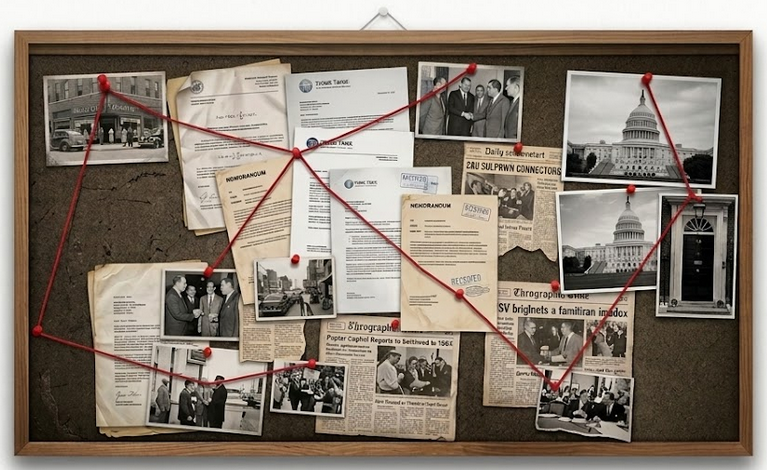
TL;DR: One charity fund in 1940s Kansas City financed Hayek, Friedman and the Mont Pelerin Society. That society’s members founded the IEA, Heritage Foundation, Cato Institute and Atlas Network. Those think tanks staffed Thatcher and Reagan’s governments. Their programme removed the constraints on US dollar creation (1971), misdiagnosed the resulting crisis as Keynesian failure, and installed the fiscal rules that now prevent any Western government from responding to the consequences. The ideas lying around in 1971 are now the walls of the room, and the room is shrinking.
Kansas City, 1932
William Volker was a German immigrant who made his fortune in home furnishings in Kansas City, Missouri. He was a serious philanthropist (locals called him “Mr. Anonymous” because he gave so much away without taking credit) who described himself as a “Progressive and Christian Socialist.” He set up the William Volker Charities Fund in 1932 to care for the sick, educate the public and fight the corrupt Pendergast political machine that ran Kansas City through voter intimidation and outright violence.
Volker died in 1947. His nephew Harold Luhnow took over the fund and its direction changed completely.
The pivot
Luhnow had none of his uncle’s community roots. He had served in the US Army, studied agriculture at Kansas State and once said he “learned about people from cattle.” Where Volker saw charity as a duty, Luhnow saw government as the problem. He had spent years fighting the Pendergast machine and concluded that all government intervention was suspect.
Under Luhnow, the Volker Fund stopped funding Kansas City charities and started funding something else entirely: an intellectual project to install free-market economics as the dominant framework in American (and eventually British) public life.
The fund brought Friedrich Hayek to the University of Chicago. It paid Ludwig von Mises’s salary at NYU. It financed the lectures that became Milton Friedman’s Capitalism and Freedom. It funded North American participation at the first meeting of the Mont Pelerin Society in 1947.
This was not passive philanthropy. This was, in Friedman’s own words, a strategy: “Only a crisis, actual or perceived, produces real change. When that crisis occurs, the actions that are taken depend on the ideas that are lying around.” The Volker Fund spent 25 years making sure their ideas were the ones lying around.
The Mont Pelerin Society
The Mont Pelerin Society was founded in April 1947 by Hayek, with Friedman among the 39 founding members. The William Volker Fund financed the inaugural conference. Credit Suisse covered 93% of the costs.
This was not an academic debating club. The Society’s members went on to found the think tanks that provided the intellectual infrastructure for everything that followed:
- IEA (1955): Founded by Antony Fisher, at Hayek’s direct encouragement
- Heritage Foundation (1973): Staffed Reagan’s transition; 22 of his 76 economic advisers were Mont Pelerin members
- Adam Smith Institute (1977): The Thatcher-era policy pipeline
- Cato Institute (1977): Co-founded by Ed Crane, Mont Pelerin member
- Atlas Network (1981): Fisher again, coordinating the global replication of the model
One fund. One society. Five think tanks. Two governments.
1971: the anchor is removed
George Shultz (University of Chicago, Mont Pelerin member) became Nixon’s Treasury Secretary. Friedman advised Nixon informally. Both advocated floating exchange rates, which meant removing the last constraint on how many dollars the US government could create.
On 15 August 1971, Nixon unilaterally suspended dollar-gold convertibility. The fixed exchange rate system collapsed by 1973. The intellectual framework that made this decision thinkable, and the advisers who pushed for it, came directly from the network the Volker Fund had built.
Without gold convertibility, there was no external discipline on dollar creation. The US could now run deficits without limit. This felt like freedom. It was the beginning of the end.
1973: the crisis they helped create, the cure they sold
The 1973 oil shock was an OPEC supply cut. That was not caused by the Chicago school. But the vulnerability to it was. Floating currencies were hit far harder than pegged ones would have been. Exchange rate instability amplified a supply shock into currency crises. The UK went to the IMF in 1976 for its largest ever loan.
Here is the part that matters: the resulting crisis was blamed on Keynesian economics. Not on the destruction of the international monetary framework that had kept economies stable for 25 years. The cure prescribed was the same ideology that had caused the vulnerability: monetarism, central bank independence, deregulation. The Chicago school’s further prescriptions were adopted as the solution to a problem their first prescription had helped create.
The system that was dismantled (post-war Keynesian management within the Bretton Woods framework) had produced the highest sustained growth rates, lowest inequality and most rapid infrastructure development in modern Western history. The NHS, the welfare state, the reduction of UK debt-to-GDP from over 200% to manageable levels were all achieved within that framework. Debt was not paid down through austerity. It was grown out of: productive spending grew the economy faster than borrowing grew the debt.
1979: the lock-in
Thatcher arrived with IEA briefings and Hayek’s The Constitution of Liberty as her declared intellectual foundation. She famously slammed the book on a policy meeting table and said “this is what we believe.” Friedman advised directly.
Reagan arrived in 1981 with Heritage Foundation policy papers and 22 Mont Pelerin members among his 76 economic advisers.
The solutions that had been pre-positioned over two decades were implemented: monetarism, central bank independence as institutional design, fiscal rules that constrained what elected governments could spend. Gordon Brown granted the Bank of England operational independence in May 1997, locking the framework into British institutional architecture.
The ideas that had been “lying around” were now load-bearing walls in the structure of Western economic governance.
The Volker Fund’s own ending
The fund itself collapsed into something darker. In the early 1960s, Luhnow’s management became erratic. He fired most of his staff and reorganised the fund as the Center for American Studies. The new centre hired David Hoggan (explicitly pro-Nazi sympathies, fired when this became untenable) and Rousas John Rushdoony (a theocratic Christian Reconstructionist who wanted to replace US civil law with biblical law, also fired). Gary North, Rushdoony’s future son-in-law, worked there as a summer intern in 1963. North went on to become a prominent figure in the Christian Right.
The centre closed in 1964. The remaining money eventually went to the Hoover Institution at Stanford. The fund’s files have disappeared.
The intellectual project it financed did not disappear. It became the operating system.
The 50-year free lunch
Without external discipline on spending, every US administration discovered that deficits were costless in the short term. Dollar reserve status absorbed the excess. Bush tax cuts. Iraq and Afghanistan. Financial crisis bailouts. COVID stimulus. Trump tax cuts. No political incentive to stop because the short-term price was zero.
Interest payments on US federal debt reached roughly $1 trillion annually by 2025. Debt sits at approximately 100% of GDP. The deficit is $1.9 trillion with no politically viable path to reduction, because the framework installed by the Mont Pelerin project forecloses every correction: tax rises are ideologically toxic, entitlement reform is politically suicidal, defence cuts are geopolitically impossible.
2022: the weaponisation
In February 2022, the US and allies froze roughly $300 billion of Russian central bank reserves. Every non-allied sovereign drew the same conclusion simultaneously: dollar-denominated reserves are political weapons, not neutral stores of value.
Central banks started buying gold at rates not seen in decades. The automatic demand for dollars and US Treasuries that had funded 50 years of deficits began to erode. Not as market sentiment. As sovereign strategic decision.
2026: the consequences arrive
The self-reinforcing loop is now active. Reserve erosion reduces automatic Treasury demand. Yields rise. Debt service increases. Deficits widen. Reserve status erodes further. The room narrows with every issuance cycle.
Meanwhile, the institutional architecture that the Mont Pelerin project installed prevents every correction. The UK cannot mobilise fiscally because the rules say it cannot, designed by people who wanted government permanently constrained. The US cannot reduce its deficit because the framework makes every option politically impossible. The ideas lying around in 1971 are now the walls of the room, and the room is shrinking.
Why this matters if you are asking “have I been radicalised?”
If you have recently found yourself thinking “wait, the system seems designed to benefit specific people,” you are not radicalised. You are reading the documentation.
The Mont Pelerin project was not a conspiracy. It was an open intellectual campaign, funded by identifiable donors, staffed by identifiable academics, producing identifiable policy outcomes through identifiable think tanks. Its architects wrote books about what they were doing. They gave interviews. They named their strategy. They won.
The people who tell you the current economic system is natural, inevitable, the product of immutable laws of economics, are either unfamiliar with this history or hoping you remain so. Every aspect of the framework (central bank independence, fiscal austerity, the primacy of inflation targeting over full employment, the assumption that government spending must be “funded” by taxation) was designed, installed and defended by a specific network of people over a specific period of time, using money from identifiable sources.
That does not mean every idea they had was wrong. It means the system you live under was a choice, not a law of physics. Different choices are possible. They always were.
The full analysis (with sourced evidence, probability assessments and adversarial testing) is here. The shorter version covering the dollar system specifically is here.
Jason Huxley is an infrastructure and automation engineer (ex-Royal Corps of Signals) with 30 years’ experience in large-scale enterprise systems. He is a member of the Green Party of England and Wales. His previous posts: The Dollar’s Expiry Date, The Plumbing of Post-Employment Tax and Why Brookings Gets AI Taxation Wrong.